Sunday, February 23, 2020

Fighting a Duel in late 19th Century France - Jules Jacob’s 1887 treatise “Le jeu de l’epee”


Title page for "le Jeu de l'Epee" 1887

MONSIEUR JOURDAIN: Well! This Fencing Master seems to get under your skin. I'll soon show you how impertinent you are. (He has the foils brought and gives one to Nicole). There. Demonstration: The line of the body. When your opponent thrusts in quarte, you need only do this, and when they thrust in tierce, you need only do this. That is the way never to be killed, and isn't it fine to be assured of what one does, when fighting against someone? There, thrust at me a little, to see.
NICOLE: Well then, what? (Nicole thrusts, giving him several hits).
MONSIEUR JOURDAIN: Easy! Wait! Oh! Gently! Devil take the hussy!
NICOLE: You told me to thrust.
MONSIEUR JOURDAIN: Yes, but you thrust in tierce, before you thrust in quarte, and you didn't have the patience to let me parry.
From Le Bourgeois Gentilhomme by Molière (1670)


Oil painting "Le Bourgeois Gentilhomme" by Charles Robert Leslie c.1841


Part 1 – The Authors and the Duelists

Dueling in France was on the rise in the latter part of the nineteenth century. Theodore Child, a well-known art critic and journalist residing in Paris wrote the book “The Praise of Paris” published in 1893. He included a chapter called “The Duellists”, where he described the French appetite for dueling.
“It is not to the credit of the French press, but it is a striking sign of the times, that while you seek in vain in the Parisian newspapers for three lines of honest criticism on a new book, you will find columns of letterpress devoted to the daily chronicle of the race-courses and the salles d’armes. Never has the art of fencing been taught in France with more science, and learned with greater avidity, than at the present day; and perhaps never since the times of Richelieu and the Fronde has duelling been more common in France.”
 
"Master, I must duel tomorrow, but I have never fenced. Teach me a secret thrust."
from "Masculinity and Male Codes of Honor in Modern France" by Robert Nye

The Duel in France during the latter period remained unique in that the sword continued to be in common use for the encounters. By the mid-19th century most other countries usually employed pistols, or the entire practice of dueling had declined. There are several possible reasons for the continuance of the sword in France. The sword remained a badge of honor and the mark of a gentleman. The French preferred the skill involved in fighting with the sword rather than a gun. Perhaps also, as the pistol evolved in to a more accurate and therefor deadly weapon, the sword was preferred as a weapon that defended one’s honor, but did not have to be fatal. First blood was often the end of a duel, and a simple scratch on the arm might suffice to gain satisfaction and demonstrate the expertise with the weapon.

A Duel from Harper's Weekly 1875

As Mark Twain noted in his essay on dueling:
“This pastime is as common in Austria to-day as it is in France. But with this difference--that here in the Austrian states the duel is dangerous, while in France it is not. Here it is tragedy, in France it is comedy; here it is a solemnity, there it is monkeyshines; here the duelist risks his life, there he does not even risk his shirt. Here he fights with pistol or saber, in France with a hairpin--a blunt one. Here the desperately wounded man tries to walk to the hospital; there they paint the scratch so that they can find it again, lay the sufferer on a stretcher, and conduct him off the field with a band of music.”
-From  "Dueling," in Europe and Elsewhere by Mark Twain

Twain perhaps exaggerates the harmlessness of the duel in France. Serious injuries were recorded, such as in the 1886 duel between author Robert Caze and critic Charles Vignier. The inexperienced Caze ran on to Vignier’s blade. Caze was pierced through the liver, and died 6 weeks later.


The popularity of fencing in 19th century France rose and fell throughout the era. Following the Revolution, aristocratic pursuits, fencing included, were denounced by the French people. But after the disastrous Franco-Prussian war where France suffered humiliating defeats and loss of property, the people of France began to search for ways to reassert their honor and masculinity. Fencing and dueling helped to fill this desire. The sword had always been a symbol of honor and self-respect, teaching courage and manners. Men were eager to prove their bravery through the duel.
According to Robert Nye in his book "Masculinity and Male Codes of Honor in Modern France", there was a new demand for fencing salles and masters, seen both as a source of education and training for the duel.


The foil had been considered the training sword for the duel, but academic rules began to create a system based more on the elegant display of skill by restricting the target area and emphasizing form and etiquette. Some fencing masters decided to teach a more practical system for combat. This theory was featured by the fencing master Jules Jacob, who suggested there were two styles of fencing – the foil and the dueling sword, one for the fencing room and one for the outdoors where duels were fought. This was controversial at the time, the new method being perceived as ungentlemanly and crude.

The Authors: Jules Jacob & Emile Andre 
Jules Jacob

Jules Jacob (1842-1893) was a noted French master of arms and one of the foremost fencing masters to introduce this new system. He began his career as an assistant to Hippolyte Gatechair, a French fencing master and first president of the Academy of Arms in Paris (formed in 1886) who taught lessons in the dueling sword known as the ‘widow’s lesson’. Jacob founded a salle in the Faubourg Montmartre which attracted, among other amateurs, some of the most notorious political writers of his time. Later, he became a professor at the l'Ecole d'escrime française, rue Saint-Marc, where he taught dueling sword and foil. With the increase in the popularity of dueling his method was recognized for departing from sporting practices of the “jeu de fleuret”, to become a method applicable in the field or “jeu de terrain”. This caused rancorous debate among traditional foilists. Nevertheless, his students were known for their successful duels, and it was rumored that Jacob knew several botte secreta, or secret thrusts.
  
Emile Andre (1859-1943) was co-author of “le jeu de l’epee” with Jacob. He was a sports journalist and author of numerous books on fencing and other martial arts, including “The Tricks of the Duel for epee, pistol and saber” and “The art of defending on the street with or without arms”. He was one of the founders of the magazine "L'Escrime Francaise" and an editor of the newspaper “Le Voltaire”. Besides fencing, he practiced cane, savate and stick fighting.

The Duelists: Arthur Ranc, Paul de Cassagnac and Anatole de la Forge
  
The three men who endorsed the book in the preface were all prominent fin de siècle French journalists, politicians and (because of the two professions) active duelists. They praised Jacob for his method as a useful science for the duel.

Arthur Ranc


Caricature of Arthur Ranc published in
 "Le Trombinoscope de Touchatout" in 1873


Arthur Ranc (1831-1908) was a politician and writer with an education in law, generally supporting the leftwing anti-imperialist groups in France. He was arrested several times for conspiracy, and at one time was condemned to death.
He fought at the siege of Paris during the Franco-Prussian war in 1870-71 and escaped the city in a balloon when Prussian forces captured the city.

An active contributor to the magazine La Republique francaise (a daily French newspaper), Ranc took part in the Dreyfus affair (a political scandal involving the French Republic from about 1894-1906), convinced of the innocence of Captain Dreyfuss.

 In the 1898 Picquart-Henry duel we was second to Colonel Picquart. In 1873 he fought a duel with Paul Cassagnac, and acted as a second to Georges Clemenceau. 


In addition to his purely political writings, Arthur Ranc published political novels.
In the preface Ranc begins by citing the example of a classic foilist against one of Jacob’s students. First they fenced traditional foil, where the foilist was far superior. Then he describes the match with the dueling sword.
“We started on guard. From the first engagement, the foil fencer was disoriented by attacks on the arm, leg, and head. He was not used to protecting these parts of the body; he did not think about it, and was touched five or six times in a row, before having succeeded in placing a button.”
He concludes that when fencers fight duels contesting like a foilist they were invariably beaten.

He cites some of the issues with traditional foil training used in a duel. An inexperienced swordsman may attack in any unexpected line by closing his eyes, and under these conditions there is no certainty in avoiding the attack. And even if a quick attack on your part works, if your opponent is not killed you will be unable to avoid a riposte. Ranc suggests that this game is nothing new and was known by the duelists of old.

Ranc concludes with this thought: “M. d'Alembert often said to me: ‘I strike at the wrist and riposte to the body.’ In one sentence it is the method of the field.”


Paul de Cassagnac
  Paul de Cassagnac (1842-1904) was a political journalist, a Bonapartist and a French duelist. As a foe of the Republic, he popularized the pejorative nickname La Gueuse (perhaps meaning a beggar or prostitute), referring to the supporters of the Republic. During his youth, de Cassagnac studied in Foix and Perpignan before going to Toulouse to study law. Attracted to journalism, he was employed at several newspapers and became involved in politics, which resulted in a number of duels.
Caricature of Paul de Cassagnac published in
 "Les Hommes d'aujourd'hui" 1878
One controversy earned him a duel in September 1868 against Prosper-Olivier Lissagaray, editor of The Future. Lissagaray received several wounds that incapacitated him for a month. Once recovered, he sent his witnesses back to Cassagnac to resume the affair. Cassaganac replied "No sir, I could consent to be your adversary, I hate to become your pork-butcher ..."
Though dueling in France was technically outlawed, the punishment if caught was generally lenient. For this duel, Cassagnac was sentenced to 6 days in prison and the 4 witnesses to a 50 francs fine.
He also dueled with another of Jacob’s supporters in the preface of the book, Arthur Ranc, in 1873 for their opposing political views.
He fought in the War of 1870 (Franco-Prussian War) and was taken prisoner after the battle of Sedan. Though supportive of the army and considered an anti-semite, during the Dreyfus affair he expressed doubts about the guilt of Captain Dreyfus.

In the preface de Cassagnac says of fencing that it has always consisted of first, not being touched, and then trying to touch. He prefers this teaching to the “purely material, physical, and almost beastly kind where we break foils right and wrong, mechanically and without realizing, most of the time, what we do!...What, then, was not my joy in finding…that classical, simple school, giving nothing to the unforeseen, the enemy of all fantasy, and which resolutely sacrificed the ambition of the touch of a button to the security of the parry.”

De Cassagnac says that the duel is a serious matter and it is important to know how to fight a duel. He adds that “Every father must henceforth put the sword in his son's hand, if only with that ulterior motive that the young man becomes a strong one, and he will be left alone.”

He complains of the complexity of fencing, and says “It is true that for a man who has never touched a sword, you, or any teacher, have only one lesson to teach him, one that allows him to get away with it in the best possible way. And that your responsibility would be terrible, if you gave him other counsel than that of extreme prudence.”


Anatole de La Forge
Anatole de La Forge (1820-1892) was a journalist, author and French politician. He began his career as a diplomat in Madrid. He left this position in 1848 to become a political journalist and editor of Le Siecle, a magazine favoring Republican ideals. During the War of 1870 he became a prefect of the National Defense, earning the name "defender of Saint-Quentin" for helping to repulse a column of Prussian soldiers who came to invade and occupy the city. On September 14, 1870, he was appointed Prefect of the Aisne, and in January 1871 prefect of the Basses-Pyrénées. In February 1871 he returned to journalism. De la Forge was a member of the Paris Seine from 1881 to 1889, where he was Deputy Speaker of the House.
Caricature of Anatole de la Forge published
in 
"Les Hommes d'aujourd'hui"
In his preface, de la Forge quotes Molière “The science of arms,” he says, “consists of giving and never receiving.” He says that having given this precept of Molière, Jacob’s students follow the formula.
De la Forge complains that fencing has become a business, and did not teach the serious encounter.
“Those who have learned to handle a sword do not forget that fencing is more than a simulacrum, more than recreation for the idlers of the salle.”
He congratulates Jacob on his method and his book, and considers, without too much paradox, that Jacob’s salle was the hall for the assembly of perpetual peace.


Next: PART II – Le Jeu de l’epee and The Code of Duelling

Monday, August 26, 2019

The Tomb of Sir Richard Burton


Standing in front of the tomb 2019

Burton's Tomb c. 1891
Sir Richard Francis Burton (1821-1890) was a renowned explorer of the Victorian age. He was also a prolific writer, fluent in 29 languages, was a studious anthropologist, quite possibly a spy for the British Empire, a translator of exotic and risqué books such as the Kama Sutra and Arabian Nights, and an accomplished fencer. Recently I had the opportunity to visit the unusual mausoleum where he is buried.
 
The tomb looking somewhat out of place in the catholic cemetery
FENCING BOOKS
He wrote four books dealing with fencing:  A Complete System of Bayonet Exercise (1853), A New System of Sword Exercise for the Infantry (1876), The Book of the Sword (1884), and the Sentiment of the Sword (1911 – published posthumously).


LIFE OF BURTON

In a review of Isabel Burton’s 1893 biography of Richard, the London Times said of him "Few men of our time have led a more romantic and adventurous life than the late Sir Richard F. Burton. A consummate linguist and intrepid traveler, without a rival in his varied knowledge of men, races, and religions, the hero of innumerable adventures, and of more than one almost impossible undertaking, Burton stands forth in these humdrum days as a rare and almost unique personality.”

He was born in a seaside town of Devon, England in March of 1821. His father was an Irish-born British army officer who traveled extensively during Burton’s youth. Because of this he was educated by tutors, for which fencing was one of the few lessons he enjoyed.

Burton was expelled from Oxford in 1842, after which he enlisted with the army of the East India Company. His knowledge of local languages helped his work in surveying and intelligence.


In 1853 he disguised himself as an Islamic pilgrim and visited the holy cities of Mecca and Medina, and gained fame upon the 1855 publication of his adventures in the book “Personal Narrative of a Pilgrimage to el Medinah and Meccah”. Following this he began his expedition to find the source of the Nile River in 1857 with John Hanning Speke. Controversy surrounded the bitter disagreement between the two men about their findings, which ended when Speke shot himself, either in a hunting accident of by suicide.
Isabel Burton 1869
In 1861 he married Isabel Arundell and the rest of his career involved the British Foreign Office, where the two lived in Brazil, Damascus, Syria, and finally in Trieste, Italy. He was knighted in 1886. Isabel shared in many of his adventures and activities, practicing fencing with him and with fencing-masters when he was away. 
Burton in his fencing outfit
Burton died in Trieste at the age of 69 from a heart attack. The design of the tomb was at Burton’s suggestion. Mary Lovell wrote in the Burton biography A Rage to Live that Isabel asked him if he preferred cremation. Burton replied with his usual joke “I do not want to burn before I have got to.” Not being able to cope with a burial at sea, Isabel asked if any other sort of funeral would do. “Yes,” he said, “I should like us to lie in a tent, side by side.” Burton’s funeral in England was on June 15, 1891, the tomb being completed shortly prior. Isabel died in 1896, and joined Burton in his tent.

EXTERIOR OF THE TOMB
The tomb is in the shape of a tent, not necessarily an Arab one as is often described, but more probably modeled on a tent that Richard and Isabel has used for their travels in Syria, tall enough to accommodate the 5’11’ Burton. Burton’s fascination for Arab culture is represented by such Islamic elements as the crescent and star motif around the roof edge, coupled with Isabel’s belief in Catholicism as seen by the crucifix atop the front. 
The exterior is made of Forest of Dean stone, while the inside floor is Carrara marble.

View of the tomb with the church in the background

View from the front of the tomb, where you can see the residential neighborhood in the background

PLAQUES
The front of the tomb bears three marble plaques, one styled as an open book and bearing Richard and Isabel's life dates, a larger tablet containing a memorial poem by Justin Huntly McCarthy, and a stone ribbon commemorating the donors who helped pay for the tomb. McCarthy was an Irish-born novelist and poet who translated some Persian works and helped with one of the publications of the Arabian Nights titled Lady Burton’s Edition of Her Husband’s Arabian Nights. Translated literally from the Arabic. Prepared for household reading by Justin Huntly McCarthy.


THE WINDOW
A window at the rear of the tomb can be accessed by an iron ladder. From it you can view the interior of the tomb. Now plate glass, the window was originally made of stained glass.
 
The window in the back of the tomb, where you can view the interior

Maria takes a peek, as well

 INTERIOR OF THE TOMB
 Through the window can be seen the interior of the tomb. To the left is Isabel’s mahogany coffin, and on the right is Richard’s steel coffin.
The facing wall has a mirror that reflects a small altar underneath the window. The altar holds a crucifix, censers and candleholders. Two glass flasks can be seen on the left of the altar, which are said to contain water from the sacred wells at Mecca that Burton had retrieved.
Large paintings hang over each coffin and glass lights are seen on the floor. Camel bells are strung from the ceiling which apparently would ring when the tomb door, no longer operating, was opened.
 
View from the window. Isabel's wood coffin on the left and Richard's steel coffin on the right

Looking towards the left side of the tomb (Isabel's coffin) from the window

Looking towards the right side of the tomb (Richard's coffin) from the window, with an odd glare on the bottom right.

LOCATION OF THE TOMB
The tomb is located in the churchyard of St. Mary Magdalen Roman Catholic Church. The church was built in 1852 in Mortlake, about 8.5 miles west of central London. The plot belonged to Isabel’s family. The churchyard is a short distance from the Thames, and is a quiet spot separate from the village life surrounding it.
If you plan to visit the tomb be aware that there are several churches with similar names in the London area The church can be accessed fairly easily with a train ride and a bit of walking. The address is 61 N Worple Way, Mortlake, London SW14 8PR, UK

Thursday, January 17, 2019

Notes on A Military System of Gymnastic Exercises, and A System of Fencing (1868) By Archibald Maclaren


Archibald Maclaren was an instructor of physical education and fencing. In 1864 he produced a manual on fencing for military instructors. In 1868 it was combine with his Military System of Gymnastic Exercises, with some updates. The 1868 edition was printed in London under the superintendence of Her Majesty’s Stationery Office. The General Order for Horse Guards stated:
“The Field Marshal Commanding-in-Chief has directed the following Regulations for the Gymnastic and Fencing Instruction, and for the Club Exercise, to be printed and bound together in one volume, as more convenient for reference and use than the three separate books hitherto published. By Command, Wm. PAULET, A.G.”

He produced the instructional manual during a period where there was concern that the British military physical fitness was not up to standard. The British Army was keen to open schools of physical training as a result of the Crimean War, where, as Major Frederick Hammersley said “the general health and fitness of recruits and soldiers left a good deal to be desired.”

The first part of the manual, comprising a large portion, is dedicated to the gymnastic exercises. It includes a variety of exercises covering such activities as dumb bells, bar bells, vaulting horse, rings, free climbing and escalading (the surmounting of a wall or other obstacle too elevated to be surmounted by a leap or a vault). Maclaren says of the exercises that “Every exercise comprised in the present system has been selected for its value in one of two aspects: the first, or elementary aspect, being the manner and degree in which it tends to cultivate the physical resources of the body by increasing its dexterity and rapidity of action, its strength in overcoming resistance, and its power of enduring protracted fatigue; while the second, or practical aspect, is the manner and degree in which its practice may be brought to aid directly in the professional duties of the soldier”.

A System of Fencing
Maclaren’s system should be noted for its attempt at efficiency (4 parries, rather than 8), while also giving an in depth analysis of how and why the actions are to be made. He studied fencing in France, presumably the source for most of his material. As it is a system for the military, the lessons are presented for instructors to use in individual or group lessons. The manual is laid out with an introduction and explanation for each action, followed by instructions on how to teach the action.

Maclaren begins by defining fencing, and indicates that the foil is taught because he considers the thrust to be the most effective way of disabling an opponent. The movements of fencing can be arranged under four heads:
-Preliminary Movements or Positions
-Defensive Movements or Parries
-Offensive Movements or Attacks
-Return Attacks

PART I - Preliminary Movements and Positions
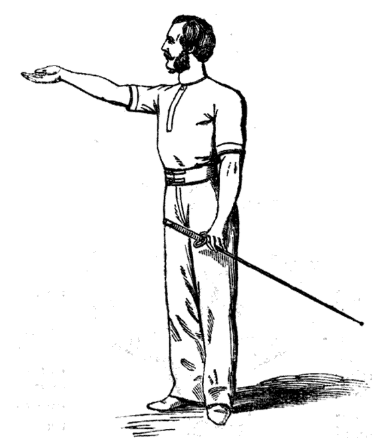
This details the movements to come on guard, starting from a position of attention and finishing in the guard.
He emphasizes that “Too much care cannot be bestowed upon the acquisition of a correct guard, for on this depends much of the force and accuracy of the movements in attack and defence.”
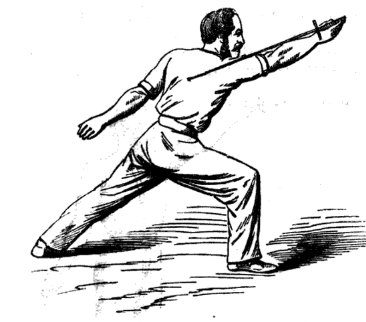
He notes that the power of the lunge comes from straightening of the left leg, and that the left hand should fall in position to within a few inches of the thigh. Maclaren concludes that the concentrated action of all the different parts of the body renders the sword-thrust so deadly.
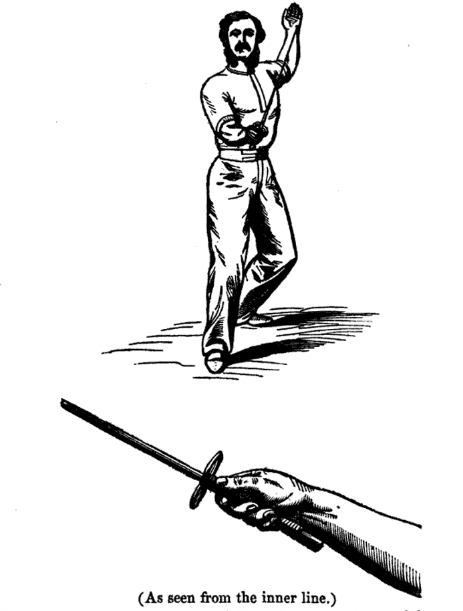
Coming On Guard


It is interesting to note that his instructions for the “longe” (lunge) were altered from his original 1864 publication. In the 1864 publication of a “System of Fencing” he instructs that in the lunge “The column of the body is not now, as in the guard, held perpendicular to the centre of the span of the lower limbs; it has partaken of their forward action, and by its fall has added to their momentum”.
By 1868 he has changed this to keeping the upright position, which was common in the French method. This may have occurred following criticism from other sources, including Richard Burton (Burton notes in his “Sword Exercise”: Mr. MacLaren, in his ' System of Fencing,' &c. sensibly advocates "resting the weight of the body equally upon both legs." He also lowers the right hand in the Lunge, and he throws the trunk forward, perhaps with a little exaggeration. Other than this criticism, though, Burton was an ardent supporter of Maclaren and preferred his gym to that of Angelo’s.)
On the Word "Thrust"

The Longe

Finally with the guard, the advance and retreat, the lunge and the recover, the “learner must be taught to execute them with faultless precision and accuracy before any attempt is made to carry him into the other divisions of the art.”
 
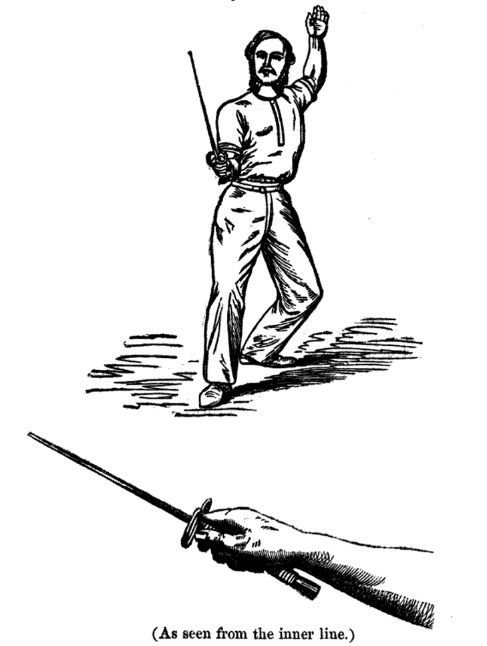
Position of the Hand in the Longe
PART II - Defensive Movements or Parries
Maclaren explains his teaching method for a group. It is to single out one man to teach, and then repeat with each individual as the others circle around to observe.
He gives an explanation of the lines. There are the inner and outer lines, and the upper and under lines. These create four openings. The parry is the special protection for each of the four openings. The defensive motions are made from the engagement. These two movements are called respectively the inner and outer engagements, or the engagements of quarte and tierce. The hand stays in the central position when pressing from the inside, and the hand turns when pressing from the outside.
Maclaren notes that in the quarte parry the hand need only pass a few inches to the inner line to make the defense, for as the attack “passed farther and farther outwards; and, although at the moment of its contact with the defending blade, it may have been made to deviate from the true line but a small fraction of an inch, yet when the longe is completed it will have passed a foot outside the most outlying portion of the breast; just as a shot quitting the muzzle of a gun, and deviating a hair's breadth from the straight line, will be many yards from it at the end of its flight, and the longer its flight the wider its deviation.”
Parry of Quarte


Parry of Tierce
 The parries of seconde and semi-circle defend the lower lines. In the semi-circle parry the point “sweeps on until it is as high as the face, and the hand is elevated a few inches, not only to complete the defence of the upper opening, but the more distinctly to expose the breast of the adversary to the return thrust. This is the Parry of Semicircle and is perhaps the most artistically formed, and in all its features, the most effective parry in the series.”
Parry of Seconde

Parry of Semicircle

He adds that there is a second defense for each line, that being the parries of Quinte, Sixte, Octave, and Prime. The object of the second defense was to give variety in the defenses, but since the same attack deceives both parries, it requires a double labor to learn. He also notes (as Angelo says) that prime is a broadsword, not a smallsword parry.

Counter parries are protection against disengages. His explanation offers an example of Maclaren’s detailed description:
“The instructor and learner are again in the position of adversaries, with the blades joined on the inner line. The instructor, extending his arm, advances his point above the learner's hand. We have seen that quarte will guard this. But were the instructor to lower his point during the extension, and thrust on the under division; or to pass a little farther and thrust on the under line outside; or go still farther, and, elevating the point, thrust above the hand outside, what then? As the attacking blade sinks from the upper to the under line, eluding the contact of the defending one as it completed its parry (quarte), the latter has but to sweep on, while the arm remains stationary forming a central point or pivot on which the hand and foil revolve, and, whether the assailing blade terminate its attack on one of the under lines, or rise above the hand on the outer line, the defending blade, if revolving with sufficient rapidity, must overtake it; and as it comes up to the point from which it started, completing its circle, will pass it off as if by its first and simple parry.' This is called a Counter Parry, and there are four of this description, corresponding to and receiving their names from, the simple parries.”

PART III - Offensive Movements or Attacks.
Maclaren defines the target as limited to between the waist and the collarbone, and extending from armpit to breastbone. On special occasions it might be further reduced to a circle of a few inches in diameter, marked on the center of this space, for the practice of accuracy. He suggests the use of this target because, besides developing accuracy, it is most likely to deliver a killing blow.
He divides attacks in to three Orders (Direct, Indirect, and Counter Attacks), which are then subdivided in to Series. After each Series are instructions on teaching the action.

For the First Order of Direct attacks, the First Series is made Under the Blade, and should be made with opposition. As the covering of one line in a defensive position exposes another, a disengagement is required. Two consecutive disengagements is called the One Two. Three separate consecutive disengagements is called the One Two Three, but is a method falling in to disuse for its complexity.

The Second Series of instruction goes around the blade, the Double to deceive the counter parry. Another example of the detail Maclaren goes in to describe the action:
“Again instructor and learner stand in front of each other, the blades joined on the inner line. The learner makes the disengagement to the outer line which the instructor parries with counter quarte. This formation of counter quarte on the disengagement to the outer line leaves the blades respectively in the same position as before the attack was made; but if, during the act of forming the counter quarte, the attacking blade keeps the lead, and as the revolving blade on the defence comes up on the outer line on its counter, neutralizing the first disengagement, the attacking blade passes to the inner line, again dips and again rises to the outer line, the original opening will be found. Thus the second movement is actually a circle formed within the larger circular defence, starting from and terminating at the opening outside above the hand…As in the One Two Three and the Counter Counter, The more complicated of these combinations are seldom made in the assault; but in the lesson they may be accurately made, and should be assiduously practiced.”

The Third Series is over the blade. This is the cut over. In addition you can make the cut over with the semi-double, and other attacks may follow the cut over, such as the one two and the double.
Maclaren notes that the cut over is more effective as a second attack than as a first. It is more easily and safely made when the adversary's point is elevated than when it is level; or when his arm is much drawn back.

Maclaren states that “combined attacks in fencing are, on a small scale facsimiles of the approaches made by a besieging force,—a series of zig-zags, getting nearer and nearer at each move to the point assailed until the intervening distance can be cleared in a final spring.”

The Second Order consists of Indirect Attacks. They are made previous to a movement of menace or assault, to distract the adversary’s attention, to disturb the security of his position, or to mislead his judgement.

The First Series is the Changement. The Second Series is the Double Engagement. The Third Series is the Beat, which drives the opposing blade a sufficient distance to enable a thrust to reach the breast. The Fourth Series is the beat reverse, an indirect attack that combines the advantages of both changement and beat. The Fifth Series is the Absence, relying on a sense of touch and anticipating a beat with the blades quit.
The sixth series is the Pressure, which consists of a slight addition to the engagement, by bringing the point lower down on the forte of the opposing blade; and although at the disadvantage of foible to forte, pressing it out of the line, until the opening desired be obtained.

The Third Order is Counter Attacks. Maclaren describes these as an alternative to a defensive movement against an indirect attack.
The First series is the Changement, which is a movement called the Counter Disengagement. The Second Series is on the Double Engagement. The same counter attacks may be made on the double engagement. The Third Series is on the Beat, and the same counter attacks may be made on the beat. If the counter attacker perceives the preparation of the beat attack, they can advance their point with opposition, and the beat will arrive too late or be delivered on the forte of the advancing blade and therefore be insufficient. The Fourth Series is on the Beat Reverse, which can be done on the counter disengagement. The Fifth Series is on the Absence and the Sixth Series is on the Pressure.

PART IV. Return Attacks (the Riposte).
Maclaren states that no parry should ever be formed without its being followed up by a return. He also notes that the parry is actually aided by the fullness of the attacker’s lunge, bringing the assailants breast close to the point of the opposing blade. The defender can lunge on the return if the adversary feels the attack parried and recovers, so Maclaren recommends that both the return with a simple extension and return with the lunge should be practiced. The returns are named after the parries from which they are made. Thus the return after the parry of quarte is called the Return in quarte; and that after the parry of tierce, the Return in tierce, &c., &c.

After the First Series of simple returns, the Second Series is the Returns Reverse to the outside line. The Third Series is Second Returns, the Fourth Series is the Double Return, the Fifth Series is Double Return Reverse, the
Sixth Series is The Return Cut-Over (This is most effective when the adversary is on the recovery of the lunge.)

Another form of Second Attack can be made from the lunge, if the adversary is careless in his return, or makes it too complicated, the attacker can remain in the lunge and parry the return, giving a second return. Maclaren notes that there is danger of exposure in lingering in the lunge, but a smart fencer can use it to bait a trap. Maclaren provides lesson in this with the straight thrust, the disengagement and the cut over.

Indirect Return Attacks are coupled with second actions, such as the beat, the graze, bindings. So for instance the defender would make a firm parry in quarte, then give a firm beat and deliver the thrust.

Irregular Attacks
These are a series of return offensive movements called time attacks, which are made during the adversary’s attack, and not at its conclusion. These differ from counter attacks, inasmuch as they are made on direct and not on indirect attacks of an adversary. They can be practiced with an opponent advancing within distance, or withdrawing their hand during the attack.

The Assault
Maclaren gives rules for the Assault. Initially the Assault should be conducted under the supervision of the instructor, and limited to selected movements. He notes that when fencing against different adversaries “No two men fence absolutely alike; and movements that are found effective against one adversary prove quite ineffective against others. All that an instructor therefore should aim at is to teach the learner the nature and purpose of the several movements as set down in his book of instructions, and to qualify him to execute them with perfect precision and the greatest possible quickness…the instructor can give him the hand, so to speak, of the swordsman, the head he must provide for himself.”

A few general rules for conducting the assault are here added.
1. All exposed parts of the body to be thoroughly protected. The head and face by a strong, hand-wrought wire mask. The neck and breast by a stout leather jacket reaching from the chin to a few inches below the waist, with a well-fitting collar buttoning (behind) around the neck. The lower part of the body by a leather flap or apron, either attached to the jacket or buckled round the waist. The right hand by a soft and pliable leather glove or gauntlet, well padded on the back.
2. The adversaries to fall on guard beyond hitting distance.
3. .When both adversaries longe at the same time, and both hits are on the targets, to count for neither; if only one hit be on the target, such hit to count.
4. When both adversaries thrust at the same time, but one only with the longe, and both hits are on the target, to count for the hit given on the longe.
5. It is perfectly fair to make a second attack on the same longe, but if at the time of the second attack the adversary gives a return thrust, and both hits are on the target, the return only to count.

The Salute
Maclaren then describes the Salute in Quarte and Tierce. It is “Performed on occasions or special encounters, or ‘Assaults of Arms’, as they are called, for the double purpose of suppling and preparing the fencer for the assault, and of showing in a graceful and advantageous manner to spectators the chief movements and positions of the art.”


The remainder of the fencing manual gives a listing of the class lessons. This is followed by a short exercise for a bayonet engaged with a bayonet. This is followed, for the last section, with a series of exercises for the regulation clubs, applicable to all stations where dumb and bar bells are not supplied.