Friday, September 14, 2018

Archibald Maclaren Fencing Master and Physical Educator


Archibald Maclaren


   Most of us recognize Angelo and Bertrand as as the preeminent fencing masters of London in the Victorian and Edwardian periods, but Archibald Maclaren also ran a successful school during the mid-nineteenth century.
   Archibald Maclaren (1819-1884) was a teacher of physical education, gymnastics and fencing. He contributed to the science of physical training, and it was Maclaren’s belief that fitness was the key to a successful army. His system of physical training was adopted by the British Army and the public schools in the later nineteenth century.
               Maclaren from the Adventures of Verdant Green

   Born in Edinburgh, he went to Paris around the age of 16 to study fencing, gymnastics and medicine, where he became interested in physical training. At the age of 21 he was listed as a fencing master in Oxford. His first wife was Charlotte Wheeler Talboys, who died after only 3 months of marriage in 1844. He subsequently married her sister, Gertrude in 1851 (discreetly, since marrying your deceased wife’s sister was illegal at the time). They had 3 daughters and a son. Gertrude was a classical scholar and teacher, aiding him in his gymnasium. In 1857 Maclaran's first book, The Fairy Family, A Series of Ballads & Metrical Tales was published.

Maclaren's first published book

   After successfully equipping fencing and gymnastic rooms in Oxford, in 1858 he built his own gymnasium. In 1864 Archibald Maclaren and his second wife Gertrude opened a school in Oxford, Summerfield House School (today known as Summer Fields). He was placed in charge of the Army Gymnastics Staff (which later became the Army Physical Training Corps) and his methods shared a common motto with the A.P.T.C.: “Mens sana in corpore sano”. This Latin quotation is often translated as ‘A healthy mind in a healthy body’.


   In 1869 the Clarendon Press published Maclaren's book A System of Physical Education, Theoretical and Practical. Maclaren died after a lingering illness at the age of 65 on 19 February 1884 and was buried at Summertown on 22 February.


   A book review of “Physical Education” from Macmillan’s Magazine in 1869 displayed the regard for Maclaren in his field.
   “It will be no news to the readers of this Magazine to tell them that to Mr. MacLaren of Oxford, more than to any other man living, is the cause of physical education indebted for the rapid strides it has of late effected in this country. His magnificent Gymnasium at the University, and the marvellous results there produced, constitute only a small portion of the work he has been for many years accomplishing. The British Army is now trained on his principles, and in Gymnasia invented by him. His last effort is worthy to be placed on a level with any of his former achievements. It is a little book, but it contains the refined wisdom and experience of a quarter of a century; it throws open to all the world the knowledge obtained in endless studies, experiments, and meditation.”

THE ADVENTURES OF VERDANT GREEN
   Maclaren’s fencing room and gymnasium is featured in the 1850’s novel “The Adventures of Mr. Verdant Green”, written by Cuthbert M. Bede, a pseudonym of author Edward Bradley. In the chapter “Mr. Verdant Green takes his Degree”, the gym is described.
    “At this period of his career, too, he strengthened his bodily powers by practising himself in those varieties of the "manly exercises" that found most favour in Oxford.
The adoption of some portion of these was partly attributable to his having been made a Mason; for, whenever he attended the meetings of his Lodge, he had to pass the two rooms where Mr. MacLaren conducted his fencing-school and gymnasium. The fencing-room — which was the larger of the two, and was of the same dimensions as the Lodge-room above it — was usually tenanted by the proprietor and his assistant, (who, as Mr. Bouncer phrased it, "put the pupils through their paces,") and re-echoed to the sounds of stampings, and the cries of "On guard! quick! parry! lunge!" with the various other terms of Defence and Attack, uttered in French and English. At the upper end of the room, over the fire-place, was a stand of curious arms, flanked on either side by files of single-sticks. The centre of the room was left clear for the fencing; while the lower end was occupied by the parallel bars, a regiment of Indian clubs, and a mattress apparatus for the delectation of the sect of jumpers.

   Here Mr. Verdant Green, properly equipped for the purpose, was accustomed to swing his clubs after the presumed Indian manner, to lift himself off his feet and hang suspended between the parallel bars, to leap the string on to the mattress, to be rapped and thumped with single-sticks and boxing-gloves by any one else than Mr. Blades (who had developed his muscles in a most formidable manner), and to go through his parades of quarte and tierce with the flannel-clothed assistant. Occasionally he had a fencing bout with the goodhumoured Mr. MacLaren, who — professionally protected by his padded leathern plastron — politely and obligingly did his best to assure him, both by precept and example, of the truth of the wise old saw, "mens sana in corpore sano."
   “The lower room at MacLaren's presented a very different appearance to the fencing-room. The wall to the right hand, as well as a part of the wall at the upper end, was hung around — not "With pikes, and guns, and bows," like the fine old English gentleman's,—but, nevertheless, "With swords, and good old cutlasses," and foils, and fencing masks, and fencing gloves, and boxing gloves, and pads, and belts, and light white shoes. Opposite to the door, was the vaulting-horse, on whose wooden back the gymnasiast sprang at a bound, and over which the tyro (with the aid of the spring-board) usually pitched himself headlong. Then, commencing at the further end, was a series of poles and ropes — the turning pole, the hanging poles, the rings, and the traptee, — on either or all of which the pupil could exercise himself; and, if he had the skill so to do, could jerk himself from one to the other, and finally hang himself upon the sloping ladder, before the momentum of his spring had passed away.”
  

ARCHIBALD MACLAREN AND SIR RICHARD BURTON
Sir Richard Francis Burton in fencing attire
   Maclaren was also an acquaintance of Sir Richard Francis Burton, the linguist, translator, explorer and fencer. Burton had this to say of Maclaren, whom he preferred over Angelo and his school:

   From “the Life of Captain Sir Richard Francis Burton” by Isabel Burton (1893):
   “The great solace of my life was the fencing-room. When I first entered Oxford, its only salle d'armes was kept by old Angelo, the grandson of the gallant old Italian, mentioned by Edgeworth, but who knew about as much of fencing as a French collegian after six months of salle d'armes. He was a priggish old party too, celebrated for walking up to his pupils and for whispering stagely, after a salute with the foil, "This, sir, is not so much a School of Arms as a School of Politeness." Presently a rival appeared in the person of Archibald Maclaren, who soon managed to make his mark. He established an excellent saloon, and he gradually superseded all the wretched gymnastic yard, which lay some half a mile out of the town. He was determined to make his way; he went over to Paris, when he could, to work with the best masters, published his systems of fencing and gymnastics, and he actually wrote a little book of poetry, which he called "Songs of the Sword." He and I became great friends, which friendship lasted for life. The only question that ever arose between us was touching the advisability or non advisability of eating sweet buns and drinking strong ale at the same time.”

                              Guard from System of Fencing

   And Burton continued his praise of Maclaren in his “New System of Sword Exercise for Infantry” published in 1876.
   “Nothing will here be said concerning the "goose step of the sword," the "Balance Motions," and the "Extension Motions," of the official 'Infantry Sword Exercise.' They are essentially a part of 'Squad and Setting-up Drill,' and as such they have been treated in several good manuals, especially by Serjeant-Major S. Bertram Brown: A ' Practical Guide to Squad and Setting-up Drill, in accordance with the principles laid down in Part I., Field Exercise of the Army.' Adapted for the use of Recruits, Bine Volunteers, Militia, Police Force, Schools, and Families: Illustrated with sixty-eight figures, representing each Stick and Club Exercise, Extension Motions, and Sword Exercise Positions. London: Allen and Co., 1871. 2nd Edition.' Considered in a wider sense they belong to the Branch of Science so thoroughly developed in 'A Military System of Gymnastic Exercises for the Use of Instructors: Adjutant-General's Office, Horse Guards, 1862; Physical Education,' Clarendon Press Series, Oxford, 1869; and in 'Training in Theory and Practice' (London, Macmillan, 1874), by Archibald MacLaren*, whose excellent code for the army, and whose influence with successive war ministers, as some one truly said, have aided largely in introducing that admirable training which is transforming the stiff, slow-moving grenadier of past times into the vigorous, rapid, and enduring soldier of the present day.

                         Maclaren's gym from Verdant Green

    Footnote by Burton:
   My old friend and instructor set out upon a thoroughly scientific principle, and the able way in which he has worked out his system will entitle him to the gratitude of the posters. Having established the fact that in all our popular athletic, as opposed to gymnastic, exercises, our walking and running, cricket and football, fives, tennis, and racquets, and especially rowing—which has advanced as an art but has declined as an exercise —we circumscribe the line of muscular operation by giving the greatest share of the work to the lower limbs, and by developing one half to the injury of the other; he resolved to cultivate the whole by a wider and more varied range of training; hence he supplemented "Recreative exercise" by "Educational exercise," and hence his systematized national gymnasia, which, taken up by H.R.H. the Duke of Cambridge and by the late Sidney Herbert, have been introduced into the military stations of the Cardwell system, into Oxford and Cambridge, and into all our public schools, with one "base exception"—Eton.

   And in another footnote (Burton is the master of footnotes):
   Mr. MacLaren, in his ' System of Fencing,' &c. (p. 9), sensibly advocates "resting the weight of the body equally upon both legs." He also lowers the right hand in the Lunge (p. 11), and (ibid.) he throws the trunk forward, perhaps with a little exaggeration.

                                            Lunge (or Longe) from System of Fencing


A selected bibliography for Archilbald Maclaren:
The Fairy Family: A Series of Ballads and metrical tales illustrating the fairy mythology of Europe 1857
Training, in theory and practice 1866
A military system of gymnastic exercises and a system of fencing 1868
A system of physical education, theoretical and practical 1869

Next: A look at Maclaren's System of Fencing

Friday, September 2, 2016

Winston Churchill - School Fencing and the Victorian Saber


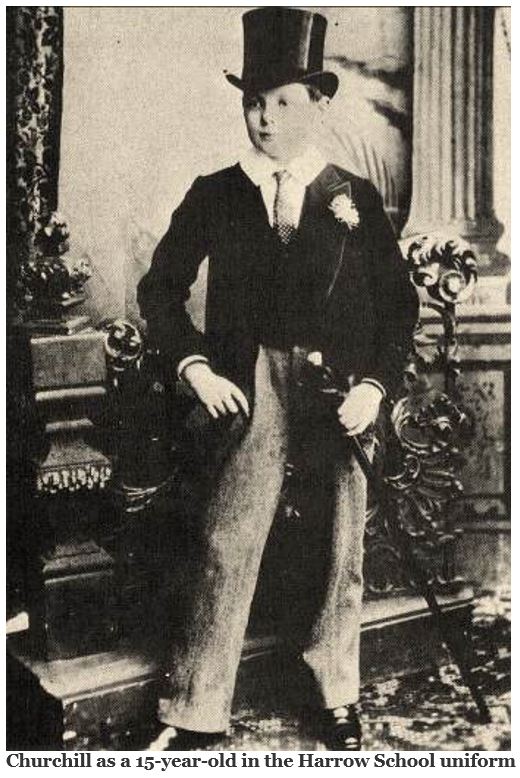
Young Winston


Fencing helped to build the character of Winston Churchill (1874-1965). From a young age he felt he was destined for greatness and invincible in battle. But the future Prime Minister of Great Britain was not an exemplary student at school. He enrolled at Harrow in 1888, and it was probably his family name that helped him to get through his academics. However, Winston excelled in subjects that appealed to him such as English and History, and he took an interest in athletics. This pursuit prompted him to write a letter to his mother Lady Randolph about a desire to take up fencing.

“I want to learn fencing. I go to the Gymnasium a great deal and I think it would be so much better for me to learn something which would be useful to me in the army, as well as affording me exercise and amusement. I’m sure, since I have been working well, you will not hesitate to sign the enclosed order and return it by post.”


Described as a small and delicate boy at 5 foot 6 inches tall with a 31 inch chest, fencing gave Winston the chance to prove himself. He took to fencing with great enthusiasm and soon became the best fencer in his school. He was gratified to earn the honor of representing Harrow in a tournament at Aldershot. The winner would be England’s public-school fencing champion.
He wrote: “My fencing is now my great employment out of school as now that I represent the School it behoves me to ‘sweat up’.”
Winston crossed foils with boys from several other schools such as Eton and Winchester. He beat them all, winning the Public Schools Fencing Championship in 1892.
He wrote home proudly: “I have won the fencing. A very fine cup. I was far and away first. Absolutely untouchable in the finals.”
Winston displayed his knack for self-promotion and attention that would follow himself in later years by having photographs made showing himself in fencing gear with his awards.

After his victory the school newspaper the Harrovian reported: "His success was chiefly due to his quick and dashing attack, which quite took his opponents by surprise."
And the paper added: “Churchill must be congratulated on his success over all his opponents in the fencing line, many of whom must have been much taller and more formidable than himself."

At 18 years of age, Winston entered Sandhurst Military Academy where he showed particular skill with horses and graduated eighth in his class of one hundred and fifty. He was commissioned as a Cornet (Second Lieutenant) in the 4th Queen's Own Hussars in 1895.

Now in the military, Winston would be armed with a sharp sword. He would serve with the 4th Hussars, and is seen photographed with two models during his service. The light cavalry sword and the heavy cavalry sword.

The light cavalry pattern saber had a slightly curved steel blade 35 1/2 inches long, suitable for both cutting and thrusting. It weighed about 2 pounds. The grip was of wood covered in fish skin and bound with silver wire. The hand-grip was protected by a steel three-bar hilt.

In 1896 light cavalry officers adopted the heavy cavalry pattern sword. It was only slightly heavier and of similar length, though straighter. The grip protection was a scroll bar made of steel.
 

Winston would rarely us the sword in battle, though he recognized its usefulness to the British campaigns in the North West Frontier (Pakistan and parts of Afghanistan) and the Sudan (Northern Africa).

Eager to see adventure and action, he entered his military career as a junior cavalry lieutenant and a war correspondent. While in the North West Frontier in 1897 he showed a rash desire to make sure he made a name for himself, riding a grey charger so that he stood out. The Afghans knew they were no match for the British using regular formations in battle. Instead, they relied on guerilla tactics and ambushes. This often resulted in fierce hand to hand combat.

During the Mamund Campaign in 1897 Winston engaged in a scene reminiscent of Indiana Jones. He was confronted by a sword wielding enemy who had just finished hacking at a wounded officer. As he later wrote in his book: “I forgot everything else at this moment except a desire to kill this man. I wore my long cavalry sword well-sharpened. After all, I had won the Public Schools fencing medal. I resolved on personal combat a l’arme blanche. The savage saw me coming. I was not more than 20 yards away. He picked up a big stone and hurled it at me with his left hand, and then awaited me, brandishing his sword. There were others waiting not far behind him. I changed my mind about the cold steel. I pulled out my revolver, took, as I thought, most careful aim, and fired. No result. I fired again. No result. I fired again. Whether I hit him or not, I cannot tell. At any rate he ran back two or three yards and plumped down behind a rock. The fusillade was continuous. I looked around. I was alone with the enemy. Not a friend was to be seen. I ran as fast as I could. There were bullets everywhere.”


Winston was also at the Battle of Omdurman in 1898, participating in one of the British Army’s last full-scale cavalry charges. The young officer wrote of the hand to hand fighting that occurred: “It was the kind of fighting they thoroughly understood. Moreover, the fight was with equal weapons, for the British too fought with sword and lance as in the days of old.”
Winston suffered from an old shoulder injury, though, and made more use of his pistol than sword.

Such exploits helped to make a name for himself, and aided his rise in politics to become one of the best known statesmen in the 20th century.


Tuesday, June 28, 2016

Burton’s Sword Exercise - Notes on the Development of Victorian Saber Fencing – Part III

A New System of Sword Exercise for Infantry by Richard F. Burton (1821-1890)


Burton’s Sword Exercise - Printed in London in 1876 by William Clowes and Sons
The dedication page.
  

Burton provides an interesting perspective on the nineteenth century sword manuals intended for military training. It is often said that the character of a person can be learned in just 5 minutes of fencing with them. This may also be true of 5 minutes of reading a fencing manual. All of Burton’s fortes and foibles are on display – his knowledge, bluster, faultfinding, and sense of humor.

Sir Richard Francis Burton was an extraordinary Victorian. He was an explorer and anthropologist, who may be most famous for not finding the source of the Nile River. His many accomplishments include a journey to Mecca disguised as a native, explorations in Africa, Asia and the Americas, and learning a vast number of languages – 29 according to Burton himself. He was also a prolific author.
 
A portrait of Burton. Note the scar on his cheek, received in Africa when a spear pierced through his face during a battle with natives.
Burton would write about anything, but the sword was a favorite subject. Besides A New System of Sword Exercise for Infantry, he wrote a treatise on bayonet fencing in 1853. The Book of the Sword (1884) is an unfinished history of the sword, and the Sentiment of the Sword: A Country House Dialogue, was published in 1911 after his death. Burton said of the sword, “The History of the sword is the history of humanity”.
He was an accredited fencing master, and his ability to compare fencing with other national systems such as German and Italian is one of the things that make this manual an interesting item. His unique contribution is the use of manchettes, a system of cuts at the arm used to disable an opponent.
 

Oil painting, 'Sir Richard Burton Dressed for Fencing', Albert Letchford, about 1883


In his introductory remarks, he lambasts contemporary English and French manuals. He states that there has been no advancement in the use of the sword.
“Whilst the last half century has witnessed an immense improvement in the projectile weapons of the civilized world, the theory and practice of the sabre or cutting arm have remained in statu quo ante; indeed, if there has been any change it is for the worse.”
He then goes on to criticize the current British military manuals as obsolete, and “nought but a snare and a delusion”. He notes that the only updates in the manuals are the uniforms in the picture plates.
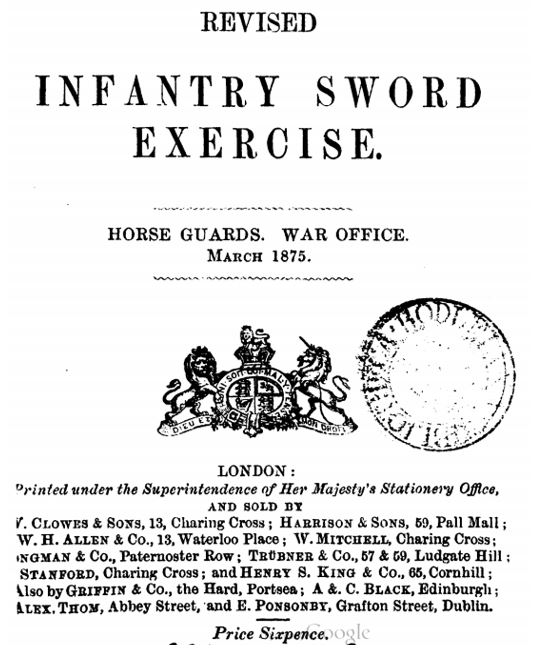
Of the Infantry Sword Exercise he says “I am opposed to almost every page of this unhappy brochure” objecting to the shape of the target, the grip of the sword, the position of the guard and the parries.

Infantry Sword Exercise (1875) Horse Guards. War Office. Printed under the supervision of Her Majesty’s Stationery Office
For example, and many of his contemporaries agree, he insists that one should “sit on guard” with the weight equally distributed on both legs. He describes the reason for the old style of keeping the bodyweight on the left leg:
“The person is not so much exposed; moreover, that the centre of gravity being thrown back adds spring and impetus to the Lunge.”
But this risks cramps in the overworked rear leg, which for Burton is enough to discard its use.
He criticizes the Guards. Of the Hanging Guard he says it is a “painful spectacle” and a “Lesson of what to avoid”. It exposes the right forearm and is fatiguing.


The inside engaging guard (carte) also endangers the forearm, and outside engaging guard (tierce) holds the hand too low and endangers the arm.


Burton calls the “loose practice” with the singlestick a mistake for learning saber. The lack of edges on the stick (which he says is simply a different weapon) lends to every blow representing a cut.

He also criticizes the simplification of terms, such as right and left for tierce and carte “as if such mysteries were too high or too deep for our national intelligence.”
Burton was not shy about criticizing the practices of the British government and military, and he developed a world view that could eschew British superiority.
He suggests that the British soldier will be equal in intelligence with the rest of Europe "When we enlist the right kind of recruit either by improving his condition and his prospects, not his pay, or better, far better, by securing a superior man through the conscription of modern Europe. We Britons are no longer physically divided from the total orb; nor can we afford to remain morally insulated and isolated. The logical effect of union with the outer world will be to make us do as the world does, and all our exceptional institutions, such as the system of volunteer recruiting, must sooner or later go by the board.”

Finished with his critical introduction, and asking that his own work be similarly scrutinized, Burton emphasizes the importance of his treatise.
“I have now finished with the ungrateful task of criticizing, and I proceed to propose a system which it is hoped will be as severely criticized by others. It is only candid to state that its pretensions are high, that it contains two distinct novelties, the Manchette System and the Reverse or Backcut; and, finally, that it aspires to be the first Treatise in which the broadsword is scientifically taken in hand.”

Section I. PREPARATORY INSTRUCTION WITHOUT THE SWORD.
Preliminary
Burton refers to the preparatory squad drills of Balance and Extension motion training as the “goose step of the sword”. Squad drill, he notes, will not likely make a good swordsman, but economy of time renders it a necessity.

First Position in Two Motions
He goes through First Position, Second Positon (the Guard), and Third Position (from Guard to Lunge). To avoid fatigue and give additional balance to the body, Burton suggests they also practice the actions standing as a left handed fencer would do.


Attacking, Advancing and Retiring
The attack Burton refers to is a beat on the ground with the right foot. He apparently is describing the appel.

Section II. PREPARATORY INSTRUCTION WITH THE SWORD
Explanation and use of the target
One of Burton’s criticisms is the depiction of the target in most saber manuals. With his typical caustic humor he notes: “to the shape of the target—I never yet saw a man absolutely circular;” This is a reference to most cutting targets depicted in saber manuals that are circular in shape, showing the directions of the cuts along the radius.
Burton’s target is oblong and the figure is five foot 8 inches tall. Showing the lines of the 12 cuts and the angle of the saber. He notes that the target “directs the recruit on how to make the cuts, but not exactly where; this must depend upon how the opponent acts during the attack and the defense.”


The Moulinet
Burton requires that this rotation movement should be learnt before the recruit proceeds to the Cut.
This section is a good example of Burton's urge to include detailed background on his subject matter. Before he gets in to the action of the moulinets, a lengthy footnote describes it as being a favorite movement of French sabrers. Most of the footnote is written in French. Burton often added quotes in Latin, French, Italian and other languages without translation. Readers had complained about his use of untranslated quotes, to which he responded that he could not help if they were not smart enough to read his books.
As for the moulinet, he says "There is nothing better for " breaking," as the French say, the recruit's wrist than this sweep of the sword; and the style of a swordsman may always be known by his Moulinet."
He divides it in three kinds: Horizontal, diagonal and vertical.


The Cuts
Of making cuts, Burton says that "The Cuts must, as a rule, be delivered within eight inches of the point and at the "centre of percussion," so that the sword may clear itself and the arm escape a "jar."
There are twelve cuts. 1 & 2 are at the head, 3 & 4 are horizontal face cuts, 5 & 6 are slanting shoulder cuts, 7 & 8 are horizontal breast cuts, 9 & 10 are horizontal stomach cuts, and 11 & 12 are slanting groin or thigh cuts, going from downwards upwards, as in the reverse of the shoulder cuts.
He adds that "The two virtues of the Cut are its trueness and its velocity."
Burton describes the various ways of making cuts, demonstrating his experience with foreign styles. His preference is what he calls the “whip cut”, which is made mostly from the wrist.


The following are the five principal ways of cutting according to Burton:—
1. The Chopping or Downright Cut, from the shoulder and fore-arm. This appears to be the instinctive method preserved by Europe; most men who take up a sword for the first time use it in this way.
2. The Sliding Cut, common throughout the East. In this movement the elbow and wrist are held stiff and the blow is given from the strong muscles of the back and shoulder, nearly ten times larger than the muscles of the arm, while the whole force and weight of the body are thrown in. Hence the people of India use small hilts with mere crutch-guards, which confine the hand and prevent the play of the wrist; the larger grip required for the Chopping Cut only lessens the cutting force. The terrible effect of these cuts is well known.
3. The Thrust Cut, with the curved (" Damascus ") blade; a combination of point and edge, the latter being obliquely thrust forward and along the body aimed at. This movement is a favourite on horseback, when speed supplies the necessary forms, which can hardly be applied on foot. It must be carried like a Point.
4. The Whip Cut; in which the arm and elbow are kept almost motionless, and the blow is delivered from the wrist. This is the principal Cut allowed in my system; it is capable of sufficient effect upon the opponent whilst it does not uncover the swordsman who uses it.
5. The Drawing or Reverse Cut, which will be explained in the following pages; it is the reverse of the "Thrust Cut."

The Engaging Guards, or Engagements.
The next section details the Engaging Guards, which Burton explains "As the 'Infantry Sword Exercise' has a deficiency of Cuts, so it has a superfluity of "Engaging Guards."
Burton reduces the Engaging to Tierce and Quarte.


He says that "When engaging in guard (joining weapons), the swords should meet each other about eight inches from the points. If the distance is diminished the opponents are "out of measure" (or distance); if increased, they are "within measure." The recruit must be taught slightly to press upon the opponent's blade, but not to rest upon it; by this "opposition" his hand and wrist will be more ready to follow the weapon during the attack."
He recommends that the right-handed recruit be taught the engaging guard of tierce, with the opponent's blade in the outer line. The reverse position leaves the fore-arm unguarded, and tierce facilitates the defense of the low lines.

The Guards or Parries.
The 'Infantry Sword Exercise' proposes Seven Guards, but Burton says that in practice the advanced swordsman will confine himself to Tierce and Carte with their natural modifications.
Of guarding the head he suggests High Tierce or High Carte (rather than Prime). To guard the legs he prefers Low Tierce or the rassemblement (withdrawing the leg) to using seconde.
The Guards or Parries will be practised like the Cuts, first in the "Second Position" (Guard), and afterwards in the "Third Position" (Lunge).


Section III. THE MANCHETTE OR FOREARM PLAY.
The manchette is cutting at the hand, wrist and forearm with the inner edge of the blade. This is Burton's distinct addition to saber exercises of the time. Burton says that "A swordsman thoroughly trained in this section does not allow the opponent to deliver a cut."
The manchette allows a swordsman to disable his opponent, rather than being forced to deliver a lethal blow. It also is a safer method of delivering a cut for the swordsman.
Burton explains "The natural man cuts as if he were using a stick or a club, and the preliminary movement lays open the whole of his body; indeed, exposure, I have said, is the main danger of every attack with the sabre, however closely and skilfully conducted. A cut through the muscles of the fore-arm, either inside or outside, causes the sword instantly to be relaxed and dropped; the man in fact is hamstrung in the upper works."
And he adds "Finally I meditated upon the comparative humanity of ‘Manchette’, of disabling the opponent by an arm-cut, rather than laying open his flank or his head. During single rencontres in the field, especially at the end of Indian battles, it is so often necessary to put hors de combat some unfortunate, whose pluck or sense of honour induces him to prolong the hopeless attack."
Burton lists his system of manchette as the Direct Cuts, The Parries and Feints, the Reverse or Back Cuts, and the Time Cuts.
The Time Cut (a cut delivered during an opponent's attack, disabling the opponent before he can finish) is the flower of the Manchette system, as the Manchette is of the broadsword; and it is, perhaps, the part least capable of being taught in books.

Burton then gives what he refers to as a synoptical table of Manchette or Forearm play, showing the Cuts, the Guards (Parries) for the Cuts, and the Ripostes or replies that should follow each Parade.


In conclusion of the manchette play, Burton says “I will end this system of Manchette with the words of old Achille Marozzo, written some three centuries and a half ago: ‘I would that ye swear upon your sword-hilts never to use this knowledge against me, your master.’ But, in lieu of insisting that my readers never teach it without obtaining formal permission, I only hope that they will favour me by spreading it far and wide.”

An Appendix to the Sword Exercises alludes to an improved form of sabre handle. Burton recommends a modified grip made by the Italian Captain Settimo del Frate. This is illustrated in the following diagrams.
 
The Italian Del Frate’s grip design for the saber.
 Burton suggests “I would further modify his Fig. 1, so as to give more fulcrum to the hand. The thumb-plate should be made weighty and the guard light, otherwise the blade will be over-balanced, that is, heavier on one side than on the other. It need hardly be said that the grip before going into battle should be whipped round with thin whipcord, or better still, with web-cloth.”

 
Burton’s modification to the grip, because he has to fiddle with everything…

 
Burton never managed to have his treatise adopted by the British military. They remained with Angelo for most of the nineteenth century. But Burton did manage to publish a manual with a unique perspective and interesting insights.