Monday, February 8, 2016


Some Notes on the Development of Victorian Saber Fencing - Part II
An examination of the fencing manual Sword Exercise, Arranged for Military Instruction by
U.S. Army Brevet Major Henry C. Wayne (1815-1883)
 
Major Henry C. Wayne, one time Director of the Sword Exercise in the U.S. Military Academy at West Point.

Sword Exercise Title Page


The United States was also producing manuals for sword exercise. Brevet Major Henry C. Wayne of the U.S. Army wrote The Sword Exercise, Arranged for Military Instruction which was published by the authority of the War Department in Washington in 1850. Wayne was at one time the Director of the Sword Exercise in the U.S. Military Academy at West Point. He was noted for having traveled to the Middle East to purchase camels for the US Department of War to test in the deserts of the western United States. The camel experiment was discontinued after the start of the American Civil War, where he became a Brigadier General in the Confederate Army.

Camels Arrive in Texas


The 1850 Manual is a combination of treatise Wayne wrote on the small sword and on the saber, both copyrighted in 1849. There are similarities to Angelo’s Infantry Sword Exercise, whether he has copied Angelo or used similar sources.

The book begins with an introduction by Wayne. “Sir: I have the honor to submit to your examination A system of Exercise on foot for the Small-Sword, Broad-Sword, Sabre, Cut and Thrust, and Stick as arranged and taught by me at the U.S. Military Academy when Director of the Sword Exercise at that institution.”
He continues: “It is submitted at the request of some of my brother officers, to supply a deficiency in our military instruction”. And adds: “As a healthy and manly amusement, improving both the morale and physique of the soldier.”

The first part is Fencing with the Small-Sword, citing the system of La Boessiere* “as the best both in theory and practice”. It is written as a more typical fencing manual, including sections on how to mount and button a foil, etc. It contains five parts.
Part I – Exercise without Foils
Part II – Exercise with Foils
Part III – Thrusts and Parries United
Part IV – Wall Practice
Part V – Cuts over the Point
 
Small-Sword Equipment
*La Boessiere pere was the 18th century French fencing master that is credited with developing the fencing mask and was instructor to the Chevalier Saint-Georges. His son, Antoine Texier La Boëssière, wrote the fencing treatise “Traité de l'art des armes à l'usage des professeurs et des amateurs”. 

Wayne follows this section with Exercise for the Broadsword, Sabre, Cut and Thrust, and Stick. He says he has compiled his information from several French and English treatise, but principally from “Porter’s Self-Defence on Foot”. He also recommends that, while the elementary parts should be practiced with a real sword, the use of wooden swords with leather guards should be substituted for metal swords in practice.

Wayne gives an explanation of a few terms not defined in the text:
Inside, Inward – the left or to the left.
Outside, Outward – the right or to the right.
Quarte, applied to the hand – nails up.
Tierce, applied to the hand – nails down.
Feeble, applied to the blade – the half from point to middle.
Fort, applied to the blade – the half from the middle to the blade.
Shoulder, applied to the blade – the joint of the blade with the hilt.

The manual contains three parts:
Part I – Exercise without Swords
Part II – Exercise with Swords
Part III – Cuts and Parries United

Part I – Exercise without Swords
The Guard position (Second Position) has the weight of the body principally on the left leg. For Wayne, this allows the fencer to retire his right leg from a cut or throw the right leg rapidly forward in a “longe”. The body is effaced as much as possible and the left hand is fixed firm on the hip bone or thrown across the small of the back. Many of the actions are performed from First Position, or standing.

The Longe (Lunge/Third Position) – Wayne recommends that a long lunge is not as important as being able to make a quick recovery. Fencers should be able to lunge from both first and second position, and recover to them nimbly.

Once the fencer is skilled in the guard, lunge and recovery, he can move on to exercises with the sword.
 

Part II – Exercise with Swords
To prevent accidents such as the sword escaping from the hand, it is necessary to have a leather sword knot.

Wayne describes the grip to be used: “The broadsword and sabre must be held with the fingers clenched round the gripe” rather than placing the thumb on the back of the grip. This is because the grip is often too short on a saber, and the weight or curvature will prove too great.

The Guards are either in Tierce or Quarte. Wayne does describe a hanging guard, but not until later in the manual. His exercises are all done from either Tierce or Quarte.
 
Guard of Quarte

Guard of Tierce


Wayne then details the use of moulinets. “The object of the Moulinet is to supple the joints of the arm and wrist, and to give dexterity in handling and whirling the blade”. Wayne only gives two – left and right, but from each engagement or guard. He then gives a series of exercises involving advancing and retreating with moulinets from both guards.

Wayne defines Traversing as footwork to the side. Particularly useful, he says, if “the retreat should be obstructed by a ditch or other impediment” and also “an antagonist may be brought in such a position as to face the sun.”
 
Moulinet Target

The Cuts
Like Angelo, there are the seven cuts that are fairly standard to instruction in the nineteenth century. Two cuts are diagonally downward, two diagonally upwards, two horizontal, and one vertically downwards. Wayne indicates they should be made principally by the motion of the wrist, keeping the arm straight and in the direction of the cut. Bending the elbow would cause “unnecessary width of motion”. The arm should be carried to the opposite of the cut to keep the body closed and not expose it to the same cut from the opponent.
 
Cuts - Direction

Wayne has the swordsman practice the first six cuts combined while advancing and retreating.

The Parries
Wayne teaches the parries of Tierce, Quarte, Seconde, Demi-circle, and Head. He recommends that when parrying a cut, to slip the right foot back to the left to avoid attacks to the leg. The parries are delivered with a straightened arm.
 
Parry of Quarte

Parry of Tierce

Parry of Seconde

Parry of Demi-Circle

Head Parry

Part III – Cuts and Parries United

Wayne has the fencers “prove distance” by standing them in first position with the swordarm straight so that the point is against the guard of the other blade. From this distance, engaged in either quarte or tierce, they practice the seven cuts and parries. The fencer delivering the cut “steps forward” with a short lunge. The fencer parrying “springs back”, returning to first position while parrying to avoid cuts to the leg.

After adding changes, disengages and feints to the drills, Wayne goes on with definitions for other actions. He uses unfamiliar terms for standard actions. This might be because of his own translations of foreign manuals, or to create his own terminology.
Bearing (Press) – forcing an adversary’s blade from the line of defense
Battering (Beat) – striking an antagonists sword to obtain an opening
Round parries – simple parry united and preceded by a counter parry.

At this point Wayne introduces the Hanging Guard and gives its advantages and objections. The Hanging Guard covers a large portion of the body, prevents thrusting below the wrist and obviates feints. It also “requires a trifling motion of the wrist to meet any cut”. The hanging guard can be tiresome, but practice can overcome this defect.
 
Hanging Guard
He also describes the “Application of the Point” in saber, which he says has fewer thrusts than the small sword due to its weight. It should be made with the hand sufficiently high to cover any cut that an adversary may be likely to make, and to retard a disengagement. The thrust should be made with opposition, either inward or outward.

Circling
This is described as making a circle of about three feet with the diameter of the point. The fencer should keep the wrist at the height of the shoulder, the weight of the body resting on the left leg, the head well back. Circling is serviceable when engaged in the dark to regain the feel of the enemy’s blade.

Wayne then illustrates some actions that deviate from the general principle of “cutting towards an antagonist’s blade”. This includes cutting both under and over the sword, and cutting at the advanced leg or thigh.

Timing is an attack made on an opponent as he changes position.

Wayne describes some Disarming actions, though he says they are not likely to succeed against a good swordsman, but useful against an indifferent one.

He finishes with some General Observations, giving a description on the use of the espadon and the stick or cudgel exercise. He then adds recommendations on opposing the small sword, espadon, bayonet and cavalry with the saber.

The salute is explained.
1st Motion – Raise the sword, held perpendicularly, point up, opposite to the right eye; guard at the height of the shoulder; elbow supported against the body.
2nd Motion – Drop the point to the front to within six or eight inches of the ground, by extending the arm downward, bringing the hand in quarte to the side of the right thigh.
3rd Motion – Recover to the position of carry swords.
Resume the first position, and engage.

Wayne ends with a comment recommending the practice of these exercises with the left hand as useful and amusing. It will develop muscles in the left arm, side and leg and be advantageous if the right arm becomes disabled during a contest.


Next: Captain Burton

Wednesday, November 18, 2015

Some Notes on the Development of Victorian Saber Fencing
(Looking at Angelo, Wayne, Burton, Hutton and Breck)

Where the foil was fenced as training with the civilian gentleman’s dueling sword, the saber still belonged to the military in the Victorian Era. Of course, this varied from country to country, with France, England, Italy and Austria all developing styles particular to their nation.
As with the foil, England and America tended to follow France, eschewing the saber as a civilian dueling weapon. Italy and Austria both developed dueling sabers in the 19th century.

In the 19th century fencing masters struggled to keep the saber as part of military drilling. Manuals were written and submitted to the army, navy, and cavalry in both America and England.

HENRY CHARLES ANGELO the Younger (1780-1852)
Henry Charles Angelo the Younger in a pencil drawing by W.H. Nightingale, 1839.
National Portrait Gallery, London
 Henry Charles Angelo is the author of Infantry Sword Exercise in 1845. He was part of the Angelo fencing dynasty established by his grandfather in England in the mid-18th century. He became Superintendent of Sword Exercise for the Army and Navy in Great Britain and his work was the standard manual for sword instruction in the Army until the end of the nineteenth century. The 1845 manual was actually a revised version originally published in 1817, though the content changed little between the editions.

Angelo explains in his introduction that “The following Instructions are laid down as the surest and quickest mode of forming Swordsmen”.

The sword featured by Angelo would have been either the 1822 or the 1845 pattern infantry officer's sword. The hilt was a half basket and "Gothic" in design. The 1822 blade would have been pipe-backed, while the redesign by Wilkinson in 1845 had a fullered blade. However, the was used for training with a variety of swords during the period.

1822 pattern infantry officer's sword with pipe-backed blade
1845 Wilkinson version with fullered blade

Section I - Extension Motions and the Positions


Since the manual is for military instruction, the drills are conducted in Lines or Files.
He begins with a series of preparatory drills of Extension Motions. These are exercises without the sword that will “expand the chest, raise the head, throw back the shoulders, and strengthen the muscles of the back” and is intended as a preparation to “give a free and active use of the limbs”. The Motions include practice of the three positions commonly taught in Victorian fencing. First Position is with the feet together and the legs straight, Second Position is what modern fencing considers On Guard, and the Third Position is the position of the lunge.
With Angelo the guard or Second Position still has the weight of the body resting on the rear foot, rather than in the center.
Angelo defines the Line of Direction as the “position of the feet, body and arms kept invariably in a straight line on the proper position of Guard…if you form your guard too wide, you are said to deviate from the Line of Direction, and consequently leave some part of your body unguarded”.

Section II – Preparatory Instruction with the Sword

Angelo presents a chart showing the seven Cuts and Guards (defense or parries). The guards are formed by the fencer opposite to the sword-hilts in the picture. The picture is meant only as a reference for correctly forming the guards and cuts, and “giving the proper direction of the edge in making the cuts”.

Angelo gives three positions for Engaging Guards – The first is simply called the Guard (which is a Hanging Guard), the second is the Inside Guard (with the hand in quarte) and finally the Outside Guard (with the hand in tierce). He then goes through a series of military movements that include Draw Swords, Recover Swords; Carry Swords; Slope Swords; and Return Swords.
 
Guard
Inside Guard
Outside Guard
 To find the proper distance for drills, Angelo uses the term “Prove Distance”, which essentially uses the lunge to find the proper distance for conducting actions. Attacks are delivered with a lunge, afterwards recovering to a position of guard.


There are Seven Cuts and Three Points (thrusts). At the command “Assault” the cuts are to be practiced in combination without any pause “as by the proper and timely turn of the wrist the Cuts will lead into each other”. This is much like Hutton’s moulinet exercise.
He notes that while each Cut has its Guard, in a true assault the fencer can use whatever is effective at the time. “He may frequently be enabled to secure himself more effectively and quicker, by forming some other guard”

The Point or Thrust is given with nails up or down. Angelo notes that “The Point being generally the most effective, should occasionally be substituted for the Cut [in practice], either in the attack, or in a quick return from a defensive Guard”. The Thrust must be made so that you cover yourself and resist his blade (opposition).

Section III is a series of Review or Inspection Exercises, varying with each Guard being formed after its respective Cut.

Section IV has the recruits putting in practice their cuts and guards with exercises for Attack and Defense. For this he recommends stick drills used for practice. This is the singlestick, already in use as a substitute for the saber.
“The sticks are to be about forty inches long, and not so weak as to bend, and leather hilts being merely large enough to cover the hand, without confining it; and on no account are the Masks to be omitted, as they enable those who practice to cut or thrust with more confidence”.

Rules for Independent Practice with Sticks is followed by General Observations and Directions and an Appendix with Words of Command throughout the Progressive Instructions of the Drill.

(Thanks to Matt Easton of Schola Gladiatoria for notes on Angelo’s Infantry Sword Exercise. Any errors are solely mine)


Next: U.S. Army Brevet Major Henry C. Wayne’s Sword Exercise, Arranged for Military Instruction

Wednesday, March 25, 2015

Fencing Old and New as Typified by Angelo and Prevost

The VFS recently participated in the Dallas Museum of Art’s Jane Austen themed Late Night program on March 22. While looking for Victorian and Regency reference material, I came across an interesting article written by H.A. Colmore Dunn in the October 1894 issue of Outing magazine. It compared fencing from the time of Angelo to the period of the late nineteenth century. Outing was an American Illustrated Monthly Magazine of sport travel and recreation that was published in the late nineteenth century. The article was titled Fencing Old and New as Typified by Angelo and Prevost.


Dunn, Angelo and Prevost
H.A. Colmore Dunn was a Barrister-at-Law and fencer in London. He published several books on fencing, including Fencing in 1889 and Dunn’s Fencing Instructor in 1891.

Dominico Angelo Malevolti Tremamondo came to England in 1755, having studied fencing in Paris under Monsieur Teillagory. Shortly after arriving he opened up his fencing academy and quickly gained fame as a fencing master. His school remained popular under several generations of Angelos.

Camille Prevost, born in London in 1853,  was the son of Pierre Prevost, who was himself a student of Baptiste Bertrand, considered one of the most influential French fencing masters of his time.
Camille Prevost took on the task of creating a comprehensive manual of foil instruction Theorie pratique de l’Escrime, presenting the principles of the French classical school according to the method of his father and Bertrand. This fencing volume was the foundation for the text of the British publication for the Badminton Library.

Changing Times
Dunn’s article attempts to look at how contemporary fencing, as typified by Camille Prevost, has changed since the time of Angelo. Dunn chose Angelo to illustrate the change because Angelo taught in England, and can therefor be compared to the methods taught contemporaneously. He notes that Prevost is similar to Angelo in that he, like Henry Angelo, was born in London and his father taught there for many years.
Dunn claims that “Although there have been numerous changes and innovations between Angelo and Prévost, these have taken in great measure the shape of rejecting superfluous movements and of developing that which already existed in the germ.”

While he stipulates that changes have occurred, the foundations of Angelo are “secure and have lasted, though much of the ornament of the superstructure has been cut away.” Dunn recognizes that Angelo’s influence kept fencing alive in England, instructing a “faithful few who ‘bent the knee’ and kept up the cult of arms.”

The basis of fencing that Angelo writes, and Dunn agrees, is that:
 “Chaque botte a sa parade et chaque parade sa riposte. La parade est la principale partie des armes. Pour étre bon tireur, il ne suffit pas de se présenter de bonne grace, de tirer avec vivacité et justesse. Le grand point est de savoir se défendre et parer les coups que l'adversaire tire."
"Every thrust has its parry and each parry its riposte. The parry is the main weapon. To be a good fencer, it is not just a show of good grace, vivacity and to thrust with accuracy. The great point is to know how to defend and ward off the blows that the enemy gives."
Dunn suggests that in a serious assault between two good fencers and on the dueling field, the parry and riposte is the fundamental tool. Dunn also notes that “Before tilting incontinently at the breast of an opponent armed with a sharp weapon, it is wise to take the preliminary course of getting his point out of the way.”

The Jump and the Pass
Dunn then goes on to point out the important changes from Angelo to Prevost.
He begins with the footwork, describing a method of breaking the measure by Angelo, “en sautant de deux pieds en arriére ;" or jumping with two feet to the rear. Dunn actually believes this is useful. “This much is evident, that in advancing or retiring on uneven ground one might likely enough stumble against an obstacle by grazing the sole of the shoe which one might have cleared by using the “saut."
However, the old-fashioned action of passing Dunn sees no use for, describing it as awkward and risky. He goes on to say of the image of the fencer performing a pass from Angelo’s book “and if they had been drawn by a later artist might have been thought to convey the pain and disgust of the one at being hit, and the surprise of the other at hitting.”
The Pass

The Position of the Guard
Perhaps Dunn’s most insistent objection is the position of the guard. Angelo taught a perfectly effaced body, to lessen the target by exposing as little surface to the opponent as possible. Dunn states that Prevost teaches that the guard should offer more of a three-quarter view “as the body is thus placed in an easy, unstrained position, ready alike to attack or defend, to advance or retire.” His objections to withdrawing the left side of the body too far are that the balance is imperiled, which causes the parries to be made too wide, and also that the speed of the lunge is impaired.

Dunn also notes other key differences to the modern position. The body is thrown back so that the balance is not centered, the hand is kept too high, and the arm extended too far from the body. This places the foible of the blade at the disposal of the forte of his adversary.

The Guard according to Angelo

the Guard according to Prevost
Voltes and the use of the left hand
Voltes and the use of the left hand to parry are no longer taught. Voltes, or the turning of the body to evade an attack, is pointed out as quite hazardous and impractical by Dunn since you are relying on pure timing to escape the point.  “It is difficult to decide whether to admire most the complete control of the limbs necessary to carry out such a maneuver, or the courage which would not hesitate to adventure all on so hazardous a chance.”
The Volte
To use the left hand to parry is also dangerous, according to Dunn. By turning the left side to your opponent you expose vital parts of your body and make awkward any movements to attack.

Parry with the left hand
 The Universal Parry
Angelo also sets forth the idea of a Universal Parry, which he calls “le cercle”. The hand is at the level of the shoulder and the point passes through all the lines.  “This parry is, unfortunately but all too truly, quite as capable of being deceived as the master who frames it.”

Conclusion
Finally, Dunn says that the distinction between Angelo and the modern school is “The rigid simplicity of movement that has taken the place of the extravagant action of former times.” Fencing in the late nineteenth century has tried to reclaim some of the simple and practical aspects of swordplay.
 “M. Prévost, the elder, boldly asked what was the good of eight parries to protect four lines; and for practical work in a serious assault it may readily be admitted that it is wiser to restrict one’s self to the best simple parries supplemented by their counters.”
 
The Lines acording to Dunn
With a respectful nod to Angelo, though, Dunn concludes with “It is not without a slight touch of regret that one closes Angelo's fascinating book.”


Saturday, September 27, 2014

The Victorian Fencing Outfit


The true fencing outfit, including mask, fencing jacket and glove came in to common use during the mid-nineteenth century, and was not regulated until after the inaugural Olympics of 1896, where international competitions began to demand uniformity in both costume and rules (rules continued to be disputed among the fencing countries, instigating the formation of the FIE, the International Fencing Federation, in 1913). Throughout the century various colors and styles were allowed, particularly for the women who at that time did not participate in competitions. The outfit changed along with the fashions of the times as well.

Paraphernalia of Fencing from 1911 Encyclopedia of Sport and Games
At the beginning of the 19th century there was not much of a fencing uniform. Even the mask, conceived by the fencing master La Boessiere in 1780, was not commonly worn, still considered ungentlemanly and showing a lack of skill. Certain customs were adopted to protect the face, such as the point of the foil being kept low and withholding the riposte after a parry until the opponent had time to recover. Images from manuals probably accurately portrayed the outfits worn, everyday clothes and a cravat or “gros mouchoir” to protect the neck.

Watercolor of Henry Angelo's Fencing Academy, by Rowlandson, 1787
from the 1829 London Encyclopedia
The early masks were solid metal with openings for the eyes and tied around the head.

Early fencing Equipment from the Diderot Encyclopedia
By 1822 the fencing outfit has become a bit more standardized. The artists George and Robert Cruickshank depict a fencing match at the rooms in St. James Street. The fencers wear a wire mesh mask that covers the face and short high collared white jackets that button up on the side. The masks do not have any bib. The fencers wear slippers or sandals on their feet. Some of the jackets in the background have color to them. It is difficult to tell if they wear gloves, but DeBast in 1836 recommends a padded glove that also protects the wrist but does not restrict it, and that the inside of the glove must very flexible.

Cruikshank's picture of fencing on St. James Street in 1822
In Maclaren’s System of Fencing published in 1864 he recommends that
“All exposed parts of the body be thoroughly protected. The head and the face by a strong, hand-wrought wire mask. The neck and the breast by a stout leather jacket reaching from the chin to a few inches below the waist, with a well-fitting collar buttoning (behind) around the neck. The lower part of the body by a leather flap or apron, either attached to the jacket or buckled round the waist. The right hand by a soft and pliable leather glove or gauntlet, well padded on the back.”
 The apron is not seen very often, probably used more often with sabre or broadsword. 
Keep in mind most of the outfit was probably custom made. Sporting equipment sellers of the later 19th century show masks, foils and gloves for sale, as well as a plastrons.

The jacket, often of canvas or some stiff material, would button on the side opposite the sword arm and was trim and waist-length. Jackets might be of leather for the practice or singlestick or sabre. Pictures of fencers often display a wide belt to denote the limit of the target area.

From an article in Frank Leslies Monthly called "Fencers and the Art of Fencing" 1893
The Fencing Mask

The fencing mask evolved from a solid piece of iron covering the face to a mesh of strong wire. Ear protectors were later added, as well as a simple bib. By the late 19th century a full bib completed the mask.

From H. A. Colmore Dunn’s book Fencing from 1889
“This should be made of good stout wire, and should always be carefully inspected before use, to see that none of the links are loose or failing, as the point of a foil has been known to find its way through the space occupied by a single link. See that the flaps are large enough to cover the ears properly, and also that the top bar across the front of the mask does not interfere with the sight.”

FOIL MASKS


The Fencing Jacket
These were generally made of a stout canvas or leather, or a combination of the two. It would button up on the side of the jacket away from the sword arm (hence right and left handed jackets would be different).
Dunn recommends that
“It is best to have the jacket made of a material which, without being too heavy, is sufficiently stiff to offer some resistance in the event of a foil breaking. Some kind of canvas seems to combine these advantages as well as anything, and, for the purposes of foil-play, is to be preferred to leather, which does better to deaden the force of a cut in stick-play than to keep out a sharp point. Take particular care that the jacket is made high in the collar, so as to protect the throat by leaving no space uncovered between it and the mask. The neglect of this precaution may lead to serious accidents, and also tends to spoil the attitude, as, if the bare throat is exposed to attack, the head is involuntarily thrust forward to protect the gap, and the result is that a cramped position is acquired, which is exceedingly difficult to cure."

George Chapman”s Foil Practice published in 1861 adds that the fencing-master should also wear a well-padded plastron or leather cuirass [chest protector], upon which the pupil during his lesson directs his foil.

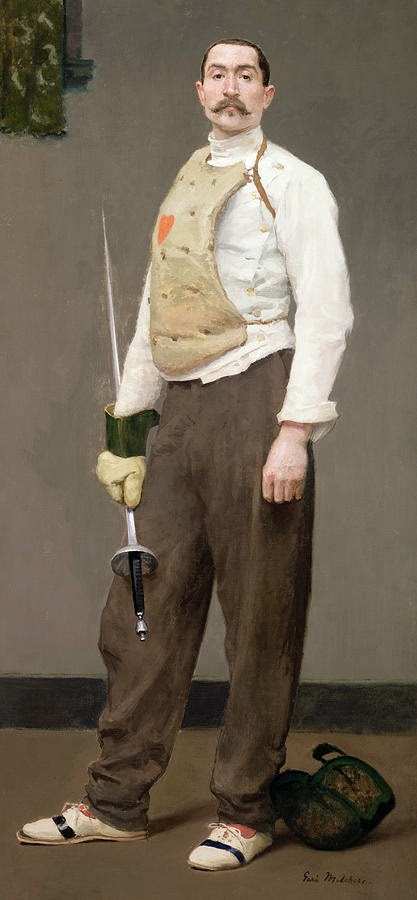
The Fencing Master by Julius Gari Melchers C. 1900 wearing a plastron with a heart
The required white uniform of today was by no means a rule in the nineteenth century. White was common, because it was easiest for the judges to see hits with the point of the foil, but there are many examples of various colored jackets. Black was not the sole property of the fencing master, and there did not seem to be any conventions concerning this. Black uniforms were used in epee contests when the chalk marks were used as a scoring device.
The black uniform went in and out of favor as this attempt at scoring was debated. Breck’s article in the Outing Magazine of 1895 congratulates an improvement in the AFLA rules that eliminates the use of chalk as a marker for scoring.
“The new laws are a vast improvement over those of last year. In the first place, the use of chalked foil-points has been abolished. To enable the four judges to see touches more easily, white jackets are required to be worn instead of the hitherto customary suits of solemn black.”

Breck still laments some of the rules and the uniform requirements that were unique to America. In the United States the target area was limited to the upper inside quarter of the jacket. Often jackets would have a line or extra patch of material to designate the target.
“It is a matter for regret that the median line rule has been retained. In France and Italy a touch counts, as it obviously should, on either side of the body. The collegians compromised by counting all touches on the right of a line drawn down the middle of the left breast, which is certainly better than the A. F. L. A. rule, the object of which is presumably to encourage accuracy. Some such provision was necessary ten years ago, but fencing in America is no longer in its swaddling clothes. There are many fencers in Paris who make a practice of placing their points on their opponents' left sides.”

Note V. Z. Post's split color jacket denoting the foil target area

Finally, in 1892 Rondelle’s Foil and Sabre: A Grammar of Fencing merely indicates that “The two costumes should be of the same color and of a strong material to avoid accidents.”

The heart on the breast of the fencing jacket was an affectation occasionally used, sometimes by the instructor, less frequently on the fencer, though Thomas Stephens mentions it in his New System of Broad and Small Sword Exercise from 1843. “An easy dress should be worn, and it is usual, in academies, to have a spot or heart on the left side of the breast of the waistcoat.”

Fencing Pants & Knickers

Trousers or pantaloons were worn by men, the color of jacket and pants generally being white or black, though this was not a rule. Pants worn followed the fashion of the time. Knee Breeches or knickers were commonly worn by men in the 18th century. Full length trousers came in to fashion in the early 19th century as part of everyday wardrobe for men, and this is often part of the fencing costume of the period Knee breeches remained associated with sporting activities such as horseback riding, golf and fencing.

Egerton Castle wearing black fencing knee breeches or knickers

Though not commonly seen, Castellote’s Handbook of Fencing in 1882 adds:
“That a leather thigh-pad is also a necessary precaution, especially when your opponent’s play is unknown to you, and you have to run the risk of its being violent or irregular.”
Many period images show a wide belt being worn. According to the Squires 1890 Catalogue of Sportsman Supplies out of New York, the fencing belt was made of red leather, three inches wide, fancy-stitched, and kid-lined. The catalogue also notes that the belt “gives strength and staying power”.
The fencing rules of the amateur Athletic Union of the United States published in the Spalding Athletic Guide of 1891 that in foil contests a fencing belt not exceeding four inches in width should be worn. The belt delineates the lower part of the target area in many rules.

Example of the Fencing Belt - Painting by Tancrede Bastet 1890

Fencing Gloves
Gloves did not seem to be used until fencing became more of a sport or exercise. A glove with a gauntlet would be worn on the hand handling the foil. There are pictures of two types. One appears to be more of a training glove, thickly padded with a leather gauntlet. The other was usually of a softer leather that enabled better manipulation for the fingers. Dunn explains the necessity of the touch of the fingers in fencing

“The selection of a glove is by no means a matter of indifference, and it is difficult to get a good one in this country. It should be just sufliciently padded to save the hand, but subject to that it should be light and flexible, so as to interfere as little as possible with the play of wrist and fingers. Most English-made gloves are exceedingly faulty in this respect, being cumbrous and shapeless, with no distinction in the length of the fingers. The padding should be properly distributed, so as to protect the parts most exposed, and particularly the tip of the thumb, which otherwise is apt to be jarred, the grasp of the foil being thereby impaired. The fingers of the glove should be well-shaped, following the configuration of the hand, so as to allow easy and independent movement. To secure ample space for the wrist, it is well to have a certain fullness at the point where the hand joins the gauntlet. To this end it is better, as in the illustration, not to cut the gauntlet straight, but to scollop a piece out of it, to be filled by the softer material of the glove, so as to give scope for the bend of the wrist. The palm should be roomy, so as to avoid cramping the thumb. If the hand is boxed up tightly in a stiff case, there is no chance of fencing neatly and lightly, as you must be sensitive to the slightest variations in the amount of pressure offered by your opponent to your blade, if you are to detect and anticipate any change in his tactics to which this pressure may be the prelude. This power of judging by the touch, which may be compared to the faculty of “hands” in horsemanship, is one of the most valuable qualities in fencing; but there is this point in the analogy in favour of the latter—that in fencing, this quality, called by the French masters “le sentiment du fer,” can, in a measure, be acquired by practice, whilst -in the case of the former it appears to be more in the nature of a fairy gift.”

Leather Fencing Glove
Padded Fencing Glove
Fencing Gauntlet


Fencing Shoes
One of the more curious parts of the outfit was the fencing shoe. An inquiry on this subject to Malcolm Fare of the National Fencing Museum in London revealed the unique nature and evolution of this apparel. He reports that:

“These days the thought of wearing a fencing shoe with a flap at the end does seem very strange, yet they were used for some 250 years. The open-toed fencing sandal for the leading foot was first depicted by De La Touche in Les vrays principes de l’espée seule, 1670. Believed to provide greater freedom of movement than an enclosed shoe, it had a sole projecting 2-3 inches beyond the toes. By the 18th century both sandals and shoes were available with a projecting flap, which was used to make a resonant sound, the appel*, during the salute.De Bast's Manuel D’Escrime, 1836, described fencing sandals as a kind of slipper, the right one being open at the end so as to give the toes freedom of movement, with the sole, which had an added layer of felt, extending some way.George Chapman in The Art of Fencing, 1864, says “The shoes should be of leather for the ‘uppers’ and of stout buff for the soles. The sole of the right shoe is frequently made with a padded flap to protect the toes from inconvenience in the fall of the foot; this addition to the shoe is not, however, of necessity.” 
 *According to Viguier’s Vocabulaire D’Escrime, 1910, appels were also used in a lesson to ensure that a pupil had good balance. During a bout they served to accentuate feints and false attacks as well as distracting the opponent. They were used to intimidate and undermine, making it possible to gain distance and execute compound hits.
 That was the theory. In practice, the flap gradually shortened during the 19th century so that by the turn of the 20th century it barely projected more than a quarter of an inch, yet was recognisably different from the shoe worn on the other foot.”


Castellote added in 1882 that if practicing outdoors you should wear light shoes with spikes, but on boarded floors the shoes should be made of soft leather for the top part and a stout buff for the soles.

The Consolidate Library Volume of 1907 adds that “Ordinary, rubber-soled tennis shoes are often worn by amateur fencers, but the regulation French fencing shoes, which have broad, leather soles are the best. The principal requirement is that the shoes shall not slip.” 

Women’s Fencing Outfit

"L'escrimeuse" by French Impressionist painter Jean Beraud


Women’s fencing outfits were not as strictly regulated since they practiced solely for exercise, not having formal competitions until 1912.

In a 1902 article in Lady’s Realm magazine the women’s outfit at the London Ladies Fencing Club is described.
“The club uniform consists of a short silk lined black alpaca skirt with the regulation brass-buttoned white linen fencing coat. The skirts are cut somewhat after the fashion of the cycling skirt, and most of the members wear black or white shoes. The stockings are either of silk or wool: the silken hose is distinctly to be recommended for daintiness and finish. A white glove with a black or scarlet gauntlet is drawn over the right hand.One very skilful and graceful woman fencer deprecates—as does Lady Colin Campbell—the wearing of a skirt. She is assured by long practice that full knickerbockers of black satin or vicuna allow unfettered and more graceful play for the limbs.”

From the Badminton Magazine article "the Art of Modern Fencing" 1907


Manriques Foil Fencing Manual of 1920 gives the additional advice that
“from a medical standpoint, it is best to protect the chest by wrapping strips of cloth across it and under the arms to form a bandage to guard against any possible bruise from being struck there with the foil button; about three yards of cheese cloth or similar material crossed and recrossed until a firm solid bandage is made as suggested.”

Fashion influenced the New York upper class ladies who fenced. They would dress in lavish elegant outfits of silk blouses designed by select tailors to cause interest among the society newspapers, who might publish sketches of the outfits. The colors and styles would be of a wide variety.

An article from Harper’s Bazaar in 1900 informs us that “Much latitude is observed in the costumes of the women who fence. While the majority wear padded linen jackets, many wear shirt-waists of any color or material to suit their taste. “Fussy” waists, however, are tabooed, and any sensible woman will recognize at once the objection – the trial to the spirit of the fencing teacher, who must be continually dodging about with his foil to avoid catching it in flowing lace or ruffles or bows.”


Examples of more fanciful ladies outfits, paintings by Joseph Arnad Koppay 


The Fencing Sword, or Foil

The fencing Foil, was made of steel, four sided and tapering to a point that was flattened out in to a small round disc called the button. The button was “usually covered with parchment or some other material to prevents damage to the opponent’s jacket and ribs” according to the instructions of Every Boy’s Book of Sport and Pastime edited by Professor Hoffman in 1897

From "Fencing" by Breck in 1915


Dunn describes the blade, as quadrangular, and about thirty-three or thirty-four inches long,
“The remaining part of the foil, tapering down from the hilt to the end, which is clenched by the “pummel,” made of steel or the like, is covered by a wooden frame called the “grip.” It is of the utmost importance that the grip should be of a good shape, following the formation of the hand when rightly placed. A straight grip, such as is occasionally met with, does not afford nearly such a comfortable, firm hold as one that is fairly arched, and fits in naturally with the curve of the thumb. It should also be of a good length, say five inches, so as to allow ample space for the hand, as, if too short, it is sure to contract and tire the muscles. Another advantage of a long grip is that, on occasion, it enables you, by slightly shifting the hand down towards the pummel, to deceive your opponent in his calculation of the extent of your reach. A fair sized pummel, say an inch and a half to two inches long, serves to balance the foil and make it come up well in the hand.”

Chapman in 1861 says
“The best foil blades are manufactured at Solingen, and those numbered 5 are mostly made use of. Open guards of iron, slightly bent upwards, or towards the point, for the better protection of the thumb, are generally used in fencing, and are more convenient than close ones. Twisted twine is the best covering for the handles, which are made of different sizes, slightly curved and more or less squared or flattened. The handle should in no case be rounded, nor should it be too much tapered towards the pummel; it should be of nearly uniform size throughout. Lastly, the pummel should not be over large, and only sufficiently weighty to balance the blade when placed on the forefinger, between two and three inches from the guard."

Both Chapman and Castellote tell us that a piece of gutta percha tied neatly over the blunted end or button of the foil will answer to prevent accidents in lunging. A hard and durable rubber or latex, gutta-percha was also used to make jewelry, grips for pistols, furniture and golf balls until other cheaper materials became easily available.

And the Consolidated Library of 1907 says that in selecting foils
choose a pair that seem to be of the right weight for your strength; it will be best for the beginner to learn with very light weapons. See that each balances, when held with the blade supported by the finger an inch from the hilt. If not provided with good-sized metal buttons, the point of the foil should be wound with good, strong, waxed cord, so as to form a button nearly half an inch in diameter; this is a desirable precaution even when metal buttons are provided. The handle should be curved, and bound with twine.”

Parts of the Foil from the 

Manuel pour l'étude des règles de l'Escrime au Fleuret et à l'Espadon published in 1860


Some fencing catalogues: Henry C. Squires from 1890 and John Piggott, Ltd. from 1905


Finally, here are some examples of fencing outfits from the1899 publication Escrimeurs Contemporains by Henry de Gourdourville. The book features photographs and information on contemporary fencers.